Massachusetts requires more information on a cannabis label than on almost anything else you can buy legally. The rules run to several pages of regulation and specify everything from milligram disclosures down to a minimum text height of one sixteenth of an inch.
Most people glance at the THC percentage and stop. This is a walkthrough of everything else on there, roughly in the order you encounter it.
Start with the symbols
Two marks are required on Massachusetts cannabis packaging, and they are the fastest way to confirm you are holding a legally produced product.
The first is a red triangle containing a black cannabis leaf, with the words CONTAINS THC beneath it. It has to appear on the front or most prominently displayed panel, and it cannot be smaller than half an inch square. On edibles, a smaller version at a quarter-inch square must be stamped or imprinted on each individual serving.
The second is a red octagon, shaped like a stop sign, reading NOT SAFE FOR KIDS. Both symbols have fixed designs. Regulations prohibit stretching, distorting, or recolouring them, so a version that looks slightly off is a warning sign.
Who made it and who packaged it
Every package identifies the licensee that produced the contents by name, registration number, phone number and email. If a different licensee did the packaging, that has to be stated separately.
The retailer’s own business phone, email and website appear as well. Between those two sets of details you can trace a product back through the supply chain, which is precisely the point.
The batch number
Look for a batch number, a sequential serial number, and often a barcode. This is the single most useful number on the label.
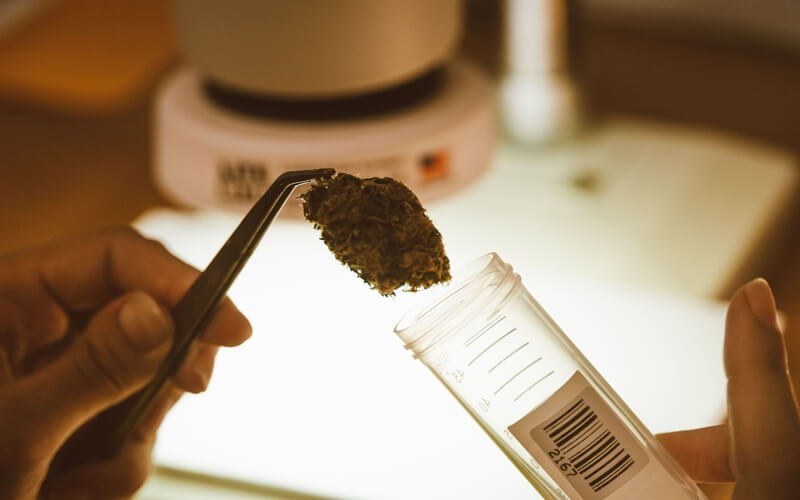
Every batch is tested independently before it can be sold. The batch number is what connects the package in your hand to that specific test result. If you ever need to check what was found, or report a problem, this is the reference that matters.
Weight and cannabinoid content
Net weight or volume appears in both US customary and metric units, in that order. That ordering is specified in the regulation, which gives a sense of how granular these rules get.
Then comes the cannabinoid profile. Massachusetts requires the full profile, not just THC. You should see delta-9 THC alongside other cannabinoids present, expressed both in absolute terms as milligrams and as a percentage.
For flower, the percentage figure is what most people look at. For anything infused, the milligram figure is more useful, because it tells you the actual quantity you are dealing with rather than a concentration.
Edibles carry extra requirements
If you are holding an edible, the label has considerably more on it.
- Serving count and the weight of a single serving in milligrams.
- A statement in a fixed format giving the THC per serving, the number of servings, and the total THC in the package.
- A full ingredient list.
- Grams of sodium, sugar, carbohydrates, and total fat per serving.
- A creation date and a use-by date, which cannot be altered once applied.
- Allergen warnings where nuts or other known allergens are present.
- Refrigeration instructions where relevant.
Massachusetts caps adult-use edibles at five milligrams of THC per serving and one hundred milligrams per package. Because laboratory testing carries a permitted variance of ten percent, the figures written into the regulation appear as 5.5 milligrams per serving and 110 milligrams per package. Both numbers describe the same rule.
There is also a homogeneity requirement. THC has to be distributed evenly through the product, so one corner of a chocolate bar cannot carry a disproportionate share of the dose.
The testing seal
Every package carries a statement and seal confirming the product was tested for contaminants, that nothing adverse was found, and the date testing took place.
Massachusetts requires testing by a licensed independent laboratory before anything reaches a shelf. Screening covers the cannabinoid profile plus contaminants including mould, mildew, heavy metals, plant growth regulators and pesticides. Finished vaporiser products get additional screening for heavy metals and vitamin E acetate.
If a laboratory finds contamination that cannot be remediated, both the laboratory and the establishment have to report it to the Commission within seventy two hours.
The certificate of analysis
The seal on the label confirms testing happened. The certificate of analysis is the underlying document with the actual numbers.
Many Massachusetts operators print a QR code linking to it or publish certificates online. This is common practice rather than a universal requirement, so if you want the full result for a specific batch and there is no code on the package, ask at the counter with the batch number in hand.
The warning text
Near the bottom you will find a block of required text, reproduced word for word from the regulation. It notes that the product has not been analysed or approved by the FDA, that information on side effects is limited, that there may be associated health risks, that use during pregnancy or breastfeeding may pose harms, and that operating a vehicle or machinery under the influence is against the law. It ends in capitals with a warning to keep the product away from children.
Edible labels add a line at the front noting that effects may be delayed by two hours or more. That sentence exists because delayed onset is the single most common reason people take too much.
Medical labels differ
Medical product labels follow parallel rules under a separate chapter of regulation. They carry the phrase Contains Marijuana. For Medical Use Only. Keep out of the reach of children, and they never include a patient’s name.
Medical products are also not bound by the five milligram serving cap that applies to adult use edibles, so doses can be higher.
A quick checklist
If you want a fast way to verify a package before you buy or consume it:
- Both required symbols present and undistorted.
- A batch number you can quote back.
- A testing seal with a date.
- Cannabinoid content in milligrams, not just a percentage.
- A use-by date on anything infused.
Every product at CANA Craft Cannabis carries this labelling, and the New Bedford menu lists cannabinoid content for each item before you arrive.
Reading the panel takes about thirty seconds once you know where to look. It is the difference between knowing what you bought and guessing.