Unlike most industries, CBD brands cannot resolve visibility challenges through paid advertising. This constraint drives every marketing decision and makes search optimization the primary growth channel for hemp brands.
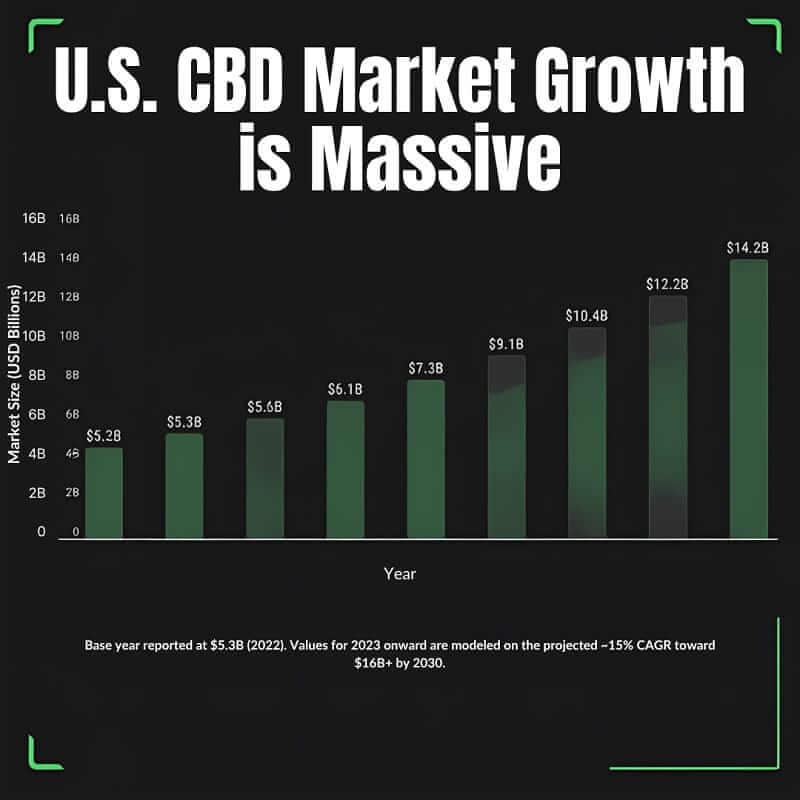
Analysts project the global cannabidiol market will reach $12 to $20 billion in 2026, with nearly 88% of the market in North America. In the United States, CBD sales may exceed $16 billion by 2030. Most of this demand is focused on a small number of widely recognized brands.
This guide addresses the key drivers of CBD SEO marketing: compliance requirements, technical foundations, content architecture, and the emerging challenge of earning citations from AI assistants.
Why Paid Advertising Still Fails Hemp Brands
Google Ads prohibits cannabis promotion under its Dangerous Products and Services policy, which applies to Search, Display, YouTube, and Shopping. The limited exceptions offer little practical benefit to most sellers.
As of 2026, the carve-out applies only to topical hemp-derived CBD products containing under 0.3% THC, requires LegitScript certification, and is regionally restricted to California, Colorado, and Puerto Rico. Ingestible CBD remains banned outright. Google did launch a search-only advertising pilot for federally licensed Canadian operators, extended through the end of 2026, but that programme does nothing for U.S. companies.
Meta and TikTok enforce similar restrictions, with narrow exceptions for topical products. Accounts are often flagged, disabled, or banned without notice or recourse.
The key takeaway: paid media is structurally unreliable in this category. Brands relying on it as a primary channel risk building growth on an unstable foundation. Organic search remains effective even when ad policies change unexpectedly.
CBD Content Sits Inside Google’s Strictest Quality Category
Search engines classify CBD content as YMYL, short for “Your Money or Your Life”. Anything touching health, finances, or safety falls into this bucket, and Google applies its highest evidentiary bar to it.
This classification immediately affects content creation. E-E-A-T, which stands for Experience, Expertise, Authoritativeness, and Trustworthiness, turns into a practical checklist:
- Use named authors with verifiable credentials. Articles attributed to “Admin” or “Staff Writer” are less competitive than those credited to professionals such as pharmacists, researchers, or cultivators with documented backgrounds. Create author bio pages, link them to professional profiles, and implement the Person schema.
- Cite primary sources directly. Link to PubMed studies, FDA guidance, and state regulatory pages instead of secondary blogs. Google distinguishes between original research citations and indirect references.
- Include visible medical or editorial review. A dated “reviewed by” line from a licensed professional provides a trust signal that low-quality sites struggle to replicate.
- Use accurate, transparent language about product limitations. Overstating cannabidiol’s effects attracts FDA and FTC scrutiny as well as typically results in lower search performance. The FDA has issued warning letters for unapproved disease claims for years. Phrasing such as “studies suggest” instead of “clinically proven to cure” protects your business and increases credibility with both algorithms and readers.
Keyword Strategy Built Around Intent, Not Volume
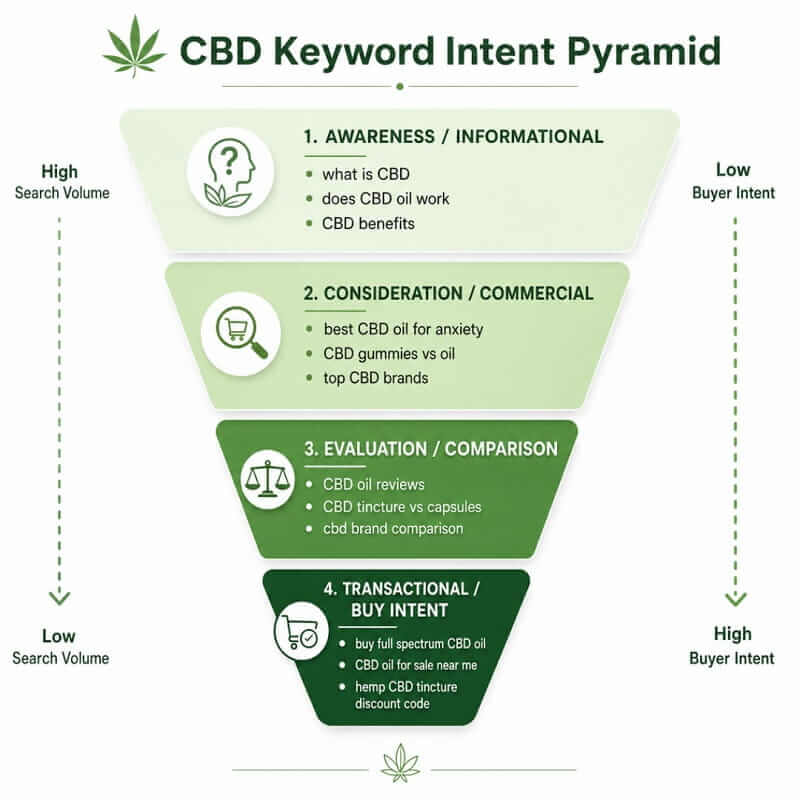
A common mistake in CBD SEO marketing is targeting broad keywords such as “CBD oil” or “buy CBD”. These queries are dominated by national brands with extensive link profiles and typically have low conversion rates due to their research-focused intent.
A more effective strategy segments keywords based on the searcher’s specific needs.
Informational queries (“Does CBD show up on a drug test?” “Full spectrum vs broad spectrum”) build topical authority and capture people early. These are your blog and resource centre pages.
Comparative queries (“CBD gummies vs tincture absorption”, “best CBD for sleep 2026”) sit closer to purchase and reward genuinely thorough content with original testing or third-party lab data.
Product and category queries (“1000mg CBD tincture”, “CBD topical for joints”) belong on optimised collection and product pages with unique descriptions, COA links, and structured data.
Local queries (“CBD store near me”, “hemp shop Grand Rapids”) matter enormously for anyone with physical retail. Local pack visibility depends on a complete Google Business Profile, consistent citations, review velocity, and location pages with genuinely distinct content rather than city names swapped into a template.
Compliance and education queries (“Is CBD legal in Texas?” “Hemp shipping restrictions”) tend to be underserved, rank quickly, and attract natural links from forums and news coverage.
Long-tail keywords in this category often have low competition and strong commercial intent. This presents an opportunity for smaller brands to succeed.
The Technical Foundation Nobody Wants to Fix
Technical debt kills more CBD sites than content quality. Technical issues undermine more CBD sites than content quality. Several problems frequently appear in site audits. Operations leave behind chains of redirects and orphaned product URLs. Age-gate overlays and interstitials, when implemented with JavaScript that blocks rendering, can prevent crawlers from seeing content at all. Faceted navigation in large product catalogues generates thousands of near-duplicate URLs, diluting the crawl budget.
Focus on the following technical fixes:
- Serve age verification in a way that does not gate content from crawlers, typically via a cookie-based overlay rather than a redirect wall.
- Canonicalize filtered and sorted URLs to their parent category.
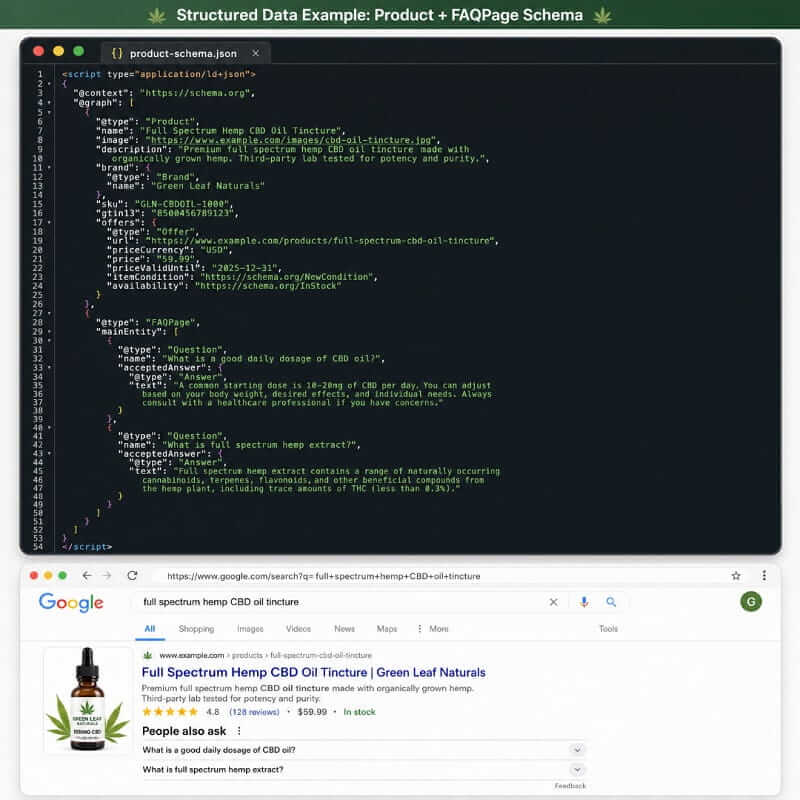
- Implement Product, Organization, FAQPage, and Article schema properly, since structured data is one of the clearest ways to communicate entity information to both search engines and AI systems.
- Audit Core Web Vitals, especially on product pages that include third-party review widgets and lab-result PDFs.
- Maintain an XML sitemap that includes only indexable, canonical URLs.
While these tasks may not be glamorous, their impact accumulates over time.
Link Building Without Ruining Your Profile
Backlinks remain a primary ranking factor, and the CBD category often tempts brands to pursue shortcuts because legitimate outreach is challenging. Avoid these tactics. Private blog networks and bulk paid placements are frequently deindexed.
Effective link building relies on original data, guest contributions to reputable industry publications, partnerships with suppliers and retailers, local sponsorships, news coverage, and expert commentary for journalists covering hemp regulation. One link from a trade publication or state cannabis association is more valuable than numerous directory submissions.
Businesses seeking guidance commonly engage specialists experienced in regulated industries, as generalist agencies may recommend paid strategies that are not viable in this sector. CBD SEO practitioners value compliance from the outset rather than as an afterthought.
The New Layer: Getting Cited by AI Assistants
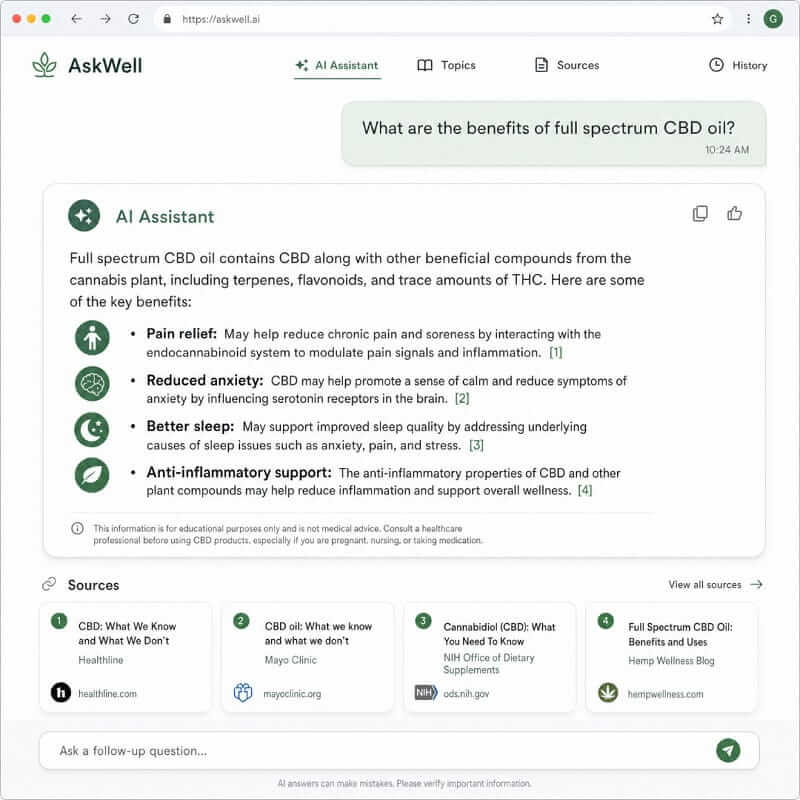
Search visibility now goes beyond Google’s traditional results. A significant portion of product research occurs within platforms such as ChatGPT, Perplexity, Gemini, Claude, and Google AI Overviews, which selectively cite sources.
Research published in 2026 examining AI reference patterns throughout the cannabis category found a highly concentrated landscape. In the CBD subcategory specifically, established brands with long-standing editorial footprints have accumulated citation density that newer entrants have struggled to approach. The reason is clear: AI systems draw on the same authority and consistency signals that traditional SEO rewards, then add a preference for content that is easy to extract and attribute.
Practical adjustments that improve AI citation odds:
- Provide direct answers early in your content. Paragraphs that state a clear answer in the first sentence are more likely to be extracted, while lengthy preambles reduce extraction likelihood.
- Structure content for easy retrieval. Employ descriptive H2 and H3 headings, brief paragraphs, definition lists, and comparison tables to facilitate clean extraction.
- Ensure entity consistency. Your brand name, product names, and business details should be identical across your website, Google Business Profile, Wikidata if applicable, and third-party listings. Inconsistencies create ambiguity and may result in your entity being overlooked.
- Secure mentions in sources trusted by AI systems. Retrieval relies on established publications, forums such as Reddit, and review aggregators. Presence in these channels indirectly enhances AI visibility.
- Keep dates and figures up to date. Recent information prompts live retrieval in several systems. Pages updated with current regulatory details are more likely to be cited than evergreen content that is outdated.
A Realistic Timeline
CBD SEO marketing requires a minimum twelve-month commitment rather than a short-term campaign. A typical sequence includes:
Months one through three go to technical cleanup, keyword mapping, and fixing E-E-A-T gaps within existing content. Months four through eight focus on publishing depth across your priority topic clusters and beginning genuine link acquisition. Months nine through twelve are where compounding usually becomes visible in traffic and revenue, and where you start optimizing based on real query data instead of assumptions.
Brands that discontinue efforts around month five, the most common failure point, invest resources without realizing any return.
Closing Thought
The advertising restrictions that make this category frustrating are also what make organic search so valuable inside it. In most industries, a competitor can outspend you on ads tomorrow. In CBD, they cannot. What they can do is publish better content, earn better links, and build a more trustworthy entity than you do, and that competition is decided by patience rather than budget.
This creates a uniquely level playing field, yet most hemp brands choose not to compete.